The trade7 min
How Moroccan saffron left the valley
Small lots, middlemen, then the growers' own desks. A cash crop with a long road out of the valley.
Saffron in this valley is a cash crop people are proud of. Households sold it in small lots, when they needed the money, and they also kept it for the table. A local telling says the crop was here before the Arab arrival in North Africa. Another telling lingers on the old name of the pistil. The stories have more than one beginning. The work is the part everyone describes the same way: corms in by hand, flowers taken at dawn, and a dry thread light enough to carry out of the valley.
Middlemen, then a desk of their own
For a long time the buyer at the door was a middleman, and the money a family received was small beside the hours in the flowers. Even so, the threads traveled. An older local account remembers them traded into other parts of Morocco and sent on to Europe. It is a proud old commerce, carried in a pocket.
An older guide to the valley remembers the saffron ground near 450 hectares, in more than 3,500 small plots, among about 2,370 households, and a crop near two tonnes in a year. A careful planting, it said, could reach about 6 kilograms a hectare in a good year, and a gentler crop after that. It is a picture of a valley full of small gardens.
Growers formed their own desks so the sale could stay with the people who had been in the field at dawn. One memory dates a cooperative to 1979, with work from the 1980 season, and a room for packing the threads. A later portrait introduces the Coopérative Agricole Taliouine in July 2004, in Tassousfi. Both dates belong to the valley. The villages, the olive oil, and the Slow Food Presidium of 2007 are on the growers.
The town around the crop
Collective work in the valley is called tiwizi. A local account says neighbors turn out together for the underground channels, the khettaras, for the open seguias, for plowing and the harvest, and again for a wedding, a baptism, or a moussem. The old collective granaries, the agadirs, were also the fortified stores. Some still stand. Their old job, as a place to hold out, has diminished.
Wool from the flocks became carpets, drawn in geometry, with a red the valley has long taken from saffron. Our photograph of a loom is on the growers, a warp of maroon, white, and black in the afternoon light.
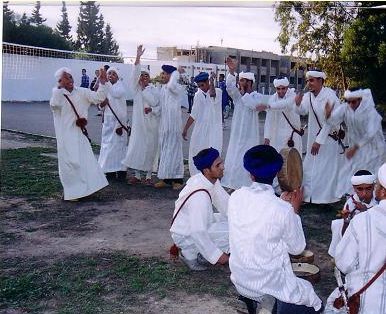
One account dates a saffron festival in the town to 2007, in the harvest weeks from late October into November. Dance in the valley is the ahouach: a line of neighbors, drums, and the pace rising. The photograph below is a celebration we saw. It is a day in the town.
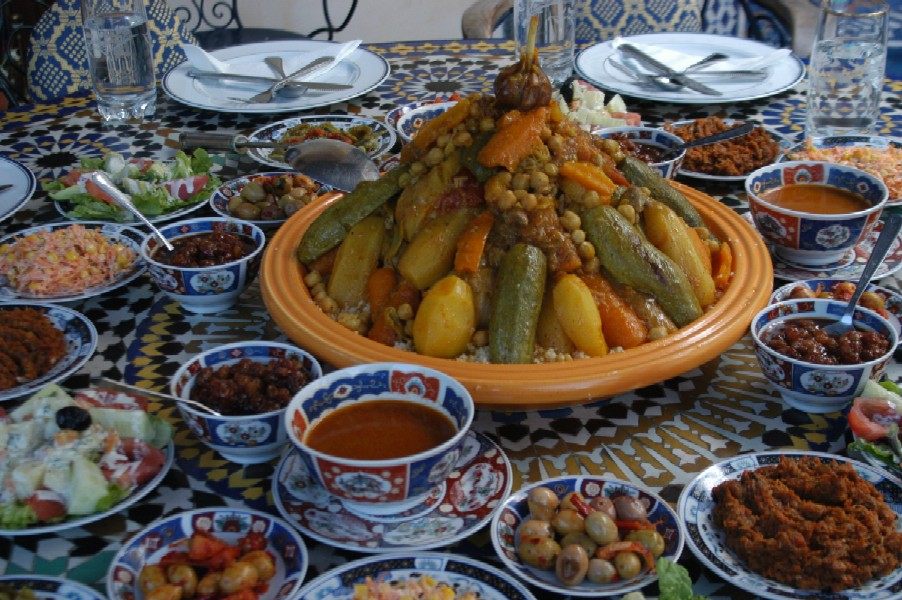
The wedding food, as a local account gives it, is on the table. A kitchen pinch stays food. The road that carries the threads out is on where the town sits.
How to look at a thread is on Saffron Threads. What a lab is asked to measure is on Saffron Grades and Saffron Quality. Once the jar is home, the cupboard is on Saffron Storage. The field account, written without this brand, is on Saffron Farming.
Also on this desk
- The townThe town the saffron is named for
- The roadWhere Taliouine sits
- The nameSafran de Taliouine
- DawnThe flowers are taken before they open
- The growersThe people who pick it, and the desks they formed
- The tinWhat to ask before you trust the word
- The tableHow the valley uses a pinch
- The brandThe brand, and the valley we love